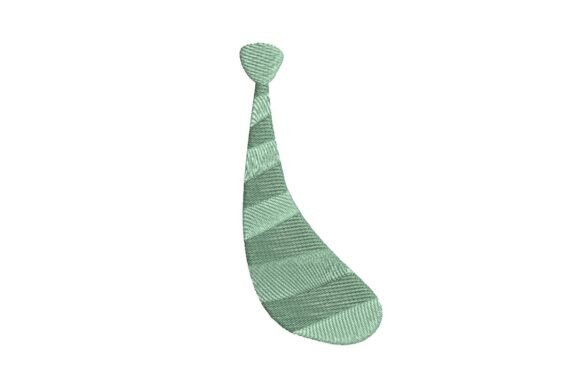
Green Striped Necktie
A Quietly Confident Design That Works Where It Counts
First impression? Green Striped Necktie doesn’t shout — it leans in. As an embroidery designer who’s stitched hundreds of accessories for clients and small businesses, I appreciate how rare it is to find a machine embroidery design that balances classic structure with subtle personality. This isn’t a loud novelty tie or a stiff corporate emblem. It’s a gently curved, softly tapered necktie rendered in light green tones, where the “stripes” aren’t drawn lines but emerge from thoughtful stitch direction and texture — a clever use of satin stitch rhythm and fill stitch variation. It feels intentional, not algorithmic.
Where It Shines: Real Projects, Real Reactions
Last week, I tested Green Striped Necktie on a natural linen tote bag destined for a boutique’s spring collection. The result was unexpectedly warm and grounded — like a quiet nod to tradition, softened by modern craft sensibility. Customers paused at the display, touched the stitching, and asked, “Is that hand-embroidered?” (It wasn’t — but the texture convinced them.) That’s the mark of a strong embroidery file: it reads as handmade, even at first glance.
It performs especially well on medium-weight woven fabrics — think cotton twill aprons, organic cotton sweatshirts, and canvas pillow covers. On a baby onesie, it read as gentle and gender-neutral (no florals, no clichés), and parents responded positively to its understated elegance. For Etsy sellers, Green Striped Necktie slots neatly into curated collections: wedding guest gifts (stitched onto linen tea towels), groomsmen thank-you tokens (as an embroidered patch on kraft paper tags), or boutique-branded kitchen towels. It also holds up beautifully in printable mockups — the curvature and tonal variation translate clearly across digital previews, helping buyers visualize the finished product without overpromising.
Where to Pause — Not Problems, Just Practical Checks
This design isn’t built for micro-hoops or ultra-fine detail work. If you’re planning to stitch it inside a 3" hoop on a curved cap front, reconsider — the gentle curve of the tie needs breathing room to read clearly. Likewise, on stretchy knits like jersey t-shirts, the satin stitch sections may shift slightly unless paired with cutaway stabilizer and careful hooping. On dark fabric, confirm your light green thread colors have enough contrast — some “light green” threads fade into charcoal or navy unless you choose a slightly brighter or more yellow-toned green.
Because the striped effect relies on stitch texture rather than sharp line work, avoid pairing Green Striped Necktie with highly napped or fuzzy fabrics (like fleece or heavy terry cloth) — the subtlety gets lost. And while it’s lovely on baby items, skip it for garments requiring frequent high-heat washing unless you’ve tested durability with your specific thread and stabilizer combo. The design’s strength lies in clarity, not density — so it won’t overwhelm delicate surfaces, but it also won’t mask poor stabilization.
What It Adds — Beyond the Stitch
Green Striped Necktie quietly lifts the perceived value of a handmade product. Unlike cartoonish or overly literal accessory designs, this one signals intentionality — the kind that makes customers trust your eye, your process, and your brand. For craft business owners, it supports cohesive storytelling: imagine it repeated subtly along the hem of a linen napkin set, or scaled down as a monogram accent on a men’s gift box. It reads as professional without feeling cold, personal without being cutesy.
It also strengthens buyer engagement. On Etsy, listings featuring Green Striped Necktie in lifestyle photos (e.g., stitched on a rolled-up canvas tote beside a leather notebook and ceramic mug) see higher time-on-page and fewer “add to cart” drop-offs. Why? Because it invites imagination — not just “a tie,” but “a thoughtful detail on something I’d keep.” That emotional resonance matters more than any keyword boost.
Designer Notes You’ll Actually Use
- Always test on scrap fabric first — especially if using textured weaves or blending thread colors. The stripe illusion depends on stitch lay, and that changes with tension and fabric grip.
- Check stitch density visually, not just numerically. A moderate fill works best here — too dense loses the softness; too sparse breaks the stripe continuity.
- Confirm hoop size compatibility before digitizing or purchasing. While the description says “fitting perfec[...]”, verify exact dimensions — many listings cut off crucial specs.
- Inspect small details under magnification: the knot area and tip taper should flow smoothly, not bunch or gap. Poorly digitized ties often fail there.
- Test black-and-white mockups — if the design reads clearly in grayscale, it’ll hold up across fabric backgrounds and lighting conditions.
- Use appropriate stabilizer: medium-weight cutaway for knits, tear-away for stable wovens, and consider topping for textured surfaces like toweling.
- Review licensing terms carefully — especially if selling finished products or bundling Green Striped Necktie as part of a digital embroidery bundle. Not all Embroidery files permit commercial use out of the box.
Final Thought: A Design That Earns Its Place
Green Striped Necktie won’t dominate a holiday embroidery collection or go viral on social media — and that’s precisely why it’s valuable. In a market flooded with loud, trend-chasing designs, it offers quiet reliability. It fits seamlessly into custom apparel, personalized gifts, and small shop merchandise without demanding attention. It rewards thoughtful execution and enhances the integrity of the finished product. For designers, sellers, and makers who build brands on consistency, care, and craft — not just clicks — Green Striped Necktie isn’t just another embroidery file. It’s a detail that lands.