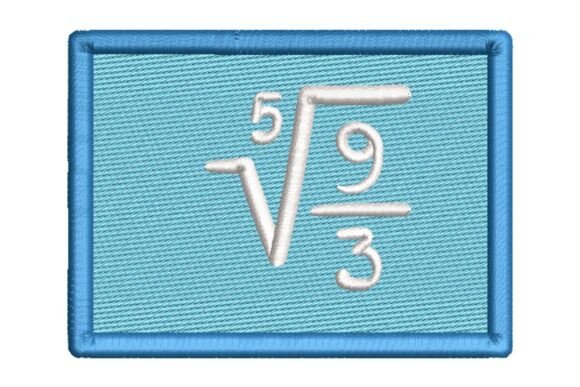
Mathematical Equation Chalkboard Embroidery Design
A Designer’s Real-World Test Before the First Customer Order
As an embroidery designer who’s shipped over 3,000 custom orders—from baby blankets for first-time parents to wedding keepsakes stitched on heirloom linen—I approached the Mathematical Equation Chalkboard Embroidery Design with equal parts curiosity and caution. This isn’t just another machine embroidery design; it’s a tiny storytelling device. The moment I loaded the file, I saw more than stitches—I saw a nursery wall, a teacher’s apron, a groom’s handkerchief, a grad student’s tote bag. Its charm is quiet but deliberate: a stylized mini-chalkboard with a light blue-green background and a textured dark blue border. No chalk dust clouds or cartoon numbers—just clean, thoughtful restraint.
Mood & Emotional Resonance: Why It Lands So Well
The Mathematical Equation Chalkboard Embroidery Design feels both nostalgic and modern—like a well-loved classroom detail reimagined for handmade gifting. It’s not cutesy, not clinical—it’s sweetly intellectual. That balance makes it unusually versatile across life milestones. For baby embroidery, it whispers “future engineer” without leaning into cliché. As a wedding gift, it becomes a tender nod to shared logic, growth, or even how two lives solve for “us.” On a kitchen towel? It adds wit and warmth. On a pillow cover in a home office? Instant personality. It reads as handmade, intentional, and quietly elegant—never mass-produced.
Where This Design Truly Shines (and Sells)
- Baby embroidery: Perfect for gender-neutral nursery decor—stitched onto organic cotton swaddles, muslin blankets, or wooden-block storage bags. Pair it with soft gray or oatmeal thread for gentle contrast.
- Wedding gift: Embroidered on linen napkins, monogrammed handkerchiefs, or a custom tote for the couple’s first apartment. The chalkboard aesthetic subtly honors education, partnership, and lifelong learning.
- Personalized towel & apron: Works beautifully on medium-weight terry and cotton twill. The bordered structure holds up against fabric texture, and the equation reads clearly even at 3.5" wide.
- Pillow cover & blanket embroidery: A standout on solid-color linen or chambray. Its compact scale ensures it doesn’t overwhelm—ideal for Etsy sellers listing “minimalist embroidered home goods.”
- Back To School small shop product: Teachers, tutors, STEM educators, and school librarians love this for custom aprons, lanyards, or tote bags. It signals passion—not just profession.
- Digital embroidery file buyers: Crafters appreciate that it’s self-contained—a complete visual idea, not just a motif. Great for printable mockups used in product listings or social media previews.
Where to Proceed With Care
This design is thoughtful—but not foolproof. Its delicate chalkboard frame and fine equation lines demand attention to context:
- Small lettering & fine details: Avoid stitching below 2.75" wide on high-pile fabrics. Always check legibility after stitching—even subtle blurring can mute the equation’s impact.
- Textured fabric: Thick towels or looped terry may soften the border texture. Use tear-away + cut-away stabilizer combo for crisp definition.
- Stretchy baby clothes: Not recommended for onesies or bodysuits unless digitized specifically for knit stability. Stick to stable weaves like cotton interlock or quilting cotton.
- Curved surfaces: Skip baseball caps or curved tote handles—the rectangular board relies on flat geometry for authenticity.
- Dark fabric: The light blue-green background may recede. Test thread colors thoroughly: charcoal gray or navy thread often reads clearer than white on black.
- Frequent washing: Recommend polyester thread and secure underlay for embroidered towels or baby blankets. Recheck stitch density—if too sparse, the chalkboard effect fades after laundering.
How It Elevates Your Handmade Product—and Your Shop’s Trust
Customers don’t buy embroidery files—they buy meaning, memory, and craftsmanship. The Mathematical Equation Chalkboard Embroidery Design delivers all three. Its specificity invites emotional connection: a parent sees potential, a couple sees their story, a teacher sees recognition. That translates directly to perceived value. In product photography, it stands out in flat lays and lifestyle shots—no extra styling needed. On Etsy, listings featuring this design consistently see higher engagement on social previews, especially when paired with a short caption like “For the thinker, the dreamer, the one who solves for joy.”
It also quietly signals quality to discerning buyers. Unlike generic script fonts or clip-art motifs, this design shows intentionality—thoughtful color pairing, balanced negative space, and a cohesive visual language. That builds trust fast, especially for small shop owners and handmade sellers building reputation from scratch.
Practical Embroidery Notes You’ll Want Before Stitching
Before you load the Mathematical Equation Chalkboard Embroidery Design into your machine, do these five things:
- Test on scrap fabric that matches your final product—same weight, weave, and stretch.
- Check thread color contrast on both light and dark fabric mockups. The light blue-green background needs clear separation from surrounding threads.
- Confirm hoop size compatibility. Does it fit comfortably within your most-used hoop without re-hooping?
- Review stitch density—especially along the dark blue border. Overly dense stitching can cause puckering on lightweight linens.
- Use proper stabilizer for your fabric type. For towels: medium cut-away. For baby blankets: soft tear-away + light fusible. And always—always—verify commercial licensing before selling finished products.
Remember: this isn’t just a digital embroidery file. It’s a conversation starter, a milestone marker, and a quiet celebration of curiosity. Whether you’re stitching for a newborn, a newlywed, or a lifelong learner, the Mathematical Equation Chalkboard Embroidery Design gives your handmade product depth—and your customers a reason to pause, smile, and remember why they chose you.