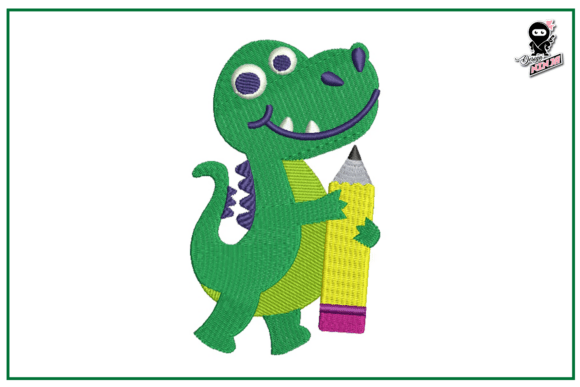
Baby Crocodile with Pencil, School
A Playful Yet Professional Anchor for Small Business Branding
As an embroidery designer who’s digitized and stitched thousands of commercial projects—from boutique aprons to café tote bags—I approached Baby Crocodile with Pencil, School with both curiosity and scrutiny. The title alone signals intention: it’s not just cute—it’s purpose-built for Back To School relevance and cross-category versatility. First impression? Friendly, confident, and surprisingly balanced—playful enough for kids’ apparel, but clean-lined and proportionally grounded to hold up on staff uniforms or branded patches. It avoids cartoonish exaggeration, which means it reads as handmade product rather than mass-produced clip art—a subtle but critical distinction for small businesses building authentic brand identity.
Where This Embroidery Design Delivers Real Business Value
Baby Crocodile with Pencil, School shines where many educational-themed designs falter: in context. A local florist launching a “Little Botanists” summer camp? Stitch it onto canvas aprons for junior staff. A handmade bakery offering “Homework Helpers” cookie boxes? Use it as a chest logo on cotton tote bags handed to school PTA volunteers. An Etsy seller curating back-to-school kits? Embed the machine embroidery design into patch sets—perfect for iron-on or sew-on application on backpacks, pencil cases, or denim jackets.
It works exceptionally well as an embroidered patch—its central silhouette (crocodile + pencil) has strong negative space and clear contours, minimizing stitch bleed on twill or felt backings. For cap embroidery, position it front-and-center on structured cotton caps: the pencil’s horizontal line anchors the composition, preventing visual float. On apron embroidery, scale it to 3–3.5 inches wide—it retains charm without overwhelming the bib area. And for tote bag design, pair it with minimal text (e.g., “Made with Smiles”) in a complementary sans-serif thread color—no extra graphics needed.
Smart Placement Requires Strategic Caution
This isn’t a one-size-fits-all digital embroidery file. Its success depends on mindful execution. Avoid using Baby Crocodile with Pencil, School below 2 inches in height—details like the pencil tip and crocodile’s eye may lose definition, especially on textured fabric like canvas or terry cloth. Curved surfaces (like cap brims or rolled sleeves) demand careful hooping; test stitch on scrap first to confirm outline integrity. On dark uniforms, prioritize high-contrast thread colors—navy crocodile with bright yellow pencil reads better than muted olive-on-black.
Watch stitch density. Though the description doesn’t specify count, the “adorable baby crocodile holding a pencil” suggests moderate fill areas—not overly dense, but not outline-only either. That’s good news: it reduces puckering risk on lightweight knits (think kids’ tees or linen-blend boutique shirts), but still delivers enough body for durable commercial embroidery. Still, always inspect spacing between elements—especially where the pencil meets the crocodile’s hand—to ensure no unintended thread bridges occur during production.
How It Strengthens Your Brand Identity—and Customer Trust
For small businesses, every embroidered element is a silent brand ambassador. Baby Crocodile with Pencil, School communicates approachability *and* competence. It says “we care about learning,” “we support growth,” and “we’re thoughtful about detail”—without saying a word. That builds recognition across touchpoints: when customers see it on your barista’s apron, then on your reusable tote, then on a limited-edition patch sold at your pop-up, consistency deepens trust.
Crucially, it elevates perceived value. Unlike generic school motifs (apples, ABC blocks), this design feels custom-curated—not templated. That aligns perfectly with buyers seeking small business merch that stands apart from big-box alternatives. On Etsy or local markets, it reinforces authenticity: a handmade pet brand using it on “Pup Tutor” bandanas signals wit and warmth; a creative studio applying it to workshop swag tells clients, “We make learning joyful.” That emotional resonance drives repeat engagement—and word-of-mouth referrals.
Essential Embroidery Designer Notes Before You Stitch
- Test in black and white first. Confirm readability and balance without color distraction—this reveals structural strengths or weaknesses instantly.
- Check small-patch viability. Resize to 1.75” and run a sample. Does the pencil remain legible? Does the crocodile’s grin read as friendly—not pinched?
- Review thread color contrast deliberately. Try matte vs. glossy threads on your target fabric—sheen affects perception of playfulness vs. polish.
- Inspect spacing and underlay. Look for tight corners or overlapping elements that could cause nesting or thread breaks at scale.
- Confirm hoop size compatibility. If your standard hoops are 4x4”, verify the design fits comfortably—tight margins increase re-hooping risk.
- Test on real fabric with proper stabilizer. A lightweight tear-away works for smooth cotton; switch to cut-away for stretchy knits or textured weaves.
- Create a printable mockup for client approval. Show it scaled on actual product photos—not just white backgrounds—to set accurate expectations.
- Compare beside other design assets. Does it harmonize with your existing logo, fonts, and palette—or does it clash tonally?
- Verify commercial licensing before business use. Since this is intended for custom apparel and resale, confirm the embroidery file includes rights for small business distribution, not just personal use.
Bottom line: Baby Crocodile with Pencil, School is more than a seasonal Embroidery download—it’s a flexible, emotionally intelligent asset for small businesses building memorable, tactile connections. Used intentionally, it transforms everyday items—caps, totes, aprons, patches—into quiet statements of care, creativity, and community. Just remember: great finished product starts long before the needle moves. Test, compare, stabilize, and align. Then stitch with confidence.